

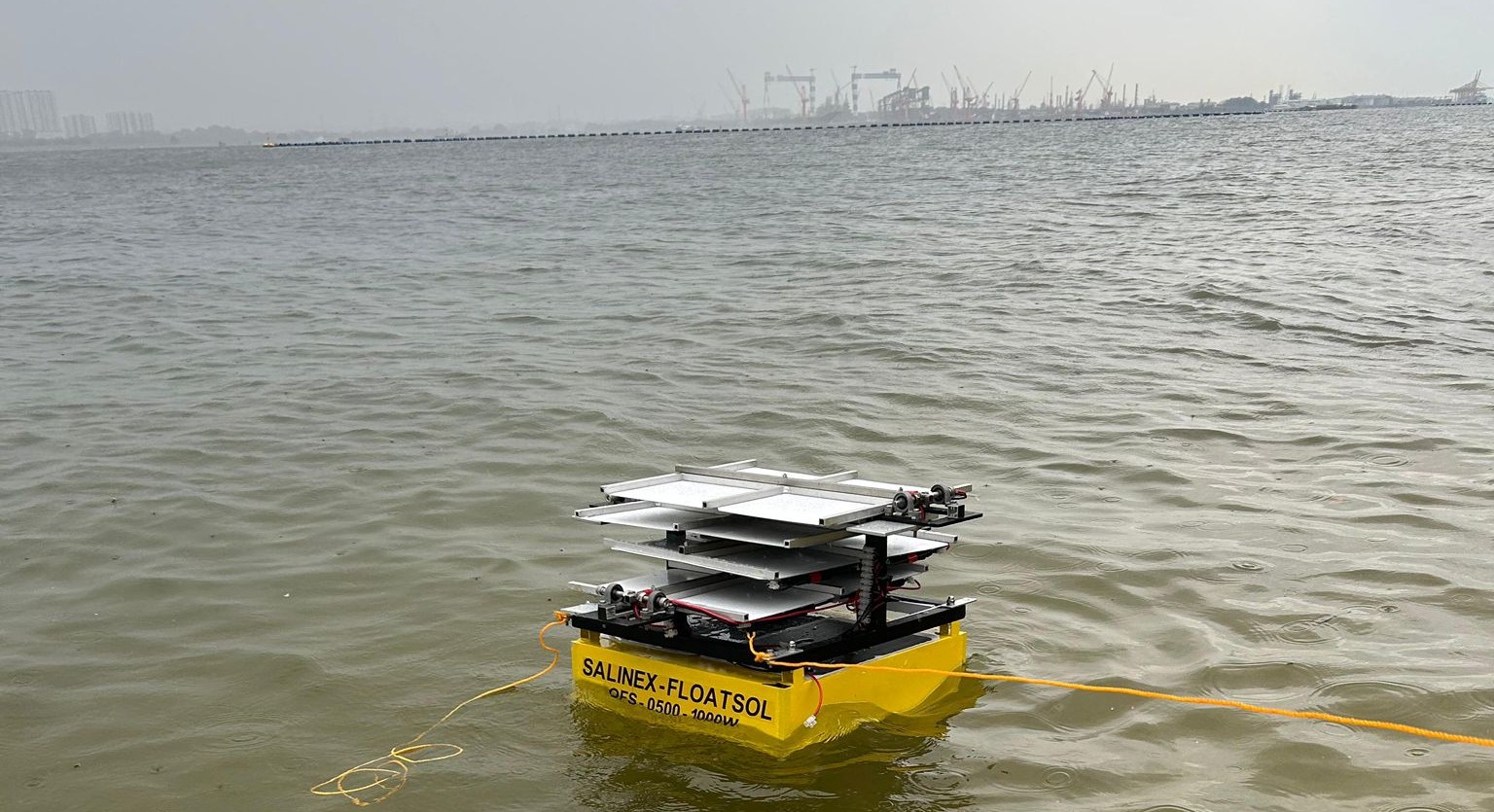
Last autumn, Salinex presented the results of nearshore testing of its offshore floating solar prototype. At the time, it was introduced as an important technical validation. This article continues that story, looking deeper into what those tests actually mean and why this prototype matters beyond the test site itself.
The 1:10 scale Offshore Semi-Submersible Floating Solar PV system, fully designed and built in Singapore, is more than a successful experiment. It shows in practice that renewable energy systems can move beyond land-based limitations and begin operating reliably at sea.
While the platform itself is compact, the idea behind it is not. It points toward a future where oceans are not just transit routes or industrial zones, but active contributors to clean energy production, freshwater generation, and potentially even green fuels.
Designed for real sea conditions
The Salinex floater is built from marine-grade aluminium, chosen for its strength, corrosion resistance, and low weight. These qualities are essential for long-term offshore use, where saltwater and constant motion place high demands on materials.
Unlike floating solar systems intended for lakes or reservoirs, this platform was engineered specifically for nearshore and offshore environments. Sea conditions are unpredictable, and the structure had to be able to respond rather than resist.
For this reason, the floater operates in two distinct modes. In normal conditions, it is deployed to maximise solar exposure and power generation. When rough weather approaches, the system shifts into a compact, stowed configuration. In this state, it can withstand wave heights of four metres or more, depending on local metocean conditions.
This adaptive approach allows the platform to remain efficient while maintaining safety. Instead of fighting the sea, the system works with it, adjusting its form as conditions change.
Built-in intelligence and data-driven control
Structural strength is only one part of the design. The prototype is also equipped with a range of IoT sensors that continuously monitor its behaviour. These include a Witmotion nine-axis inertial sensor, gyroscope, accelerometer, inclinometer, and a U-Blox Neo-M8P GPS unit.
Together, these sensors create a detailed picture of how the platform moves, tilts, and responds to environmental forces. The data collected during nearshore testing is already providing valuable insights into system performance and structural stability.
At present, the platform is remotely operated. However, future versions are planned to be sensor-assisted and semi-autonomous. This means the system will be able to interpret real-time conditions and adjust its orientation or operational mode without manual intervention.
Such autonomy reduces operational risk and improves reliability, especially in offshore locations where constant human oversight is neither practical nor efficient.
More than electricity
Although the prototype is small compared to land-based solar installations, its potential impact is notable. The expected daily energy output could support the desalination of freshwater for approximately 200 people.
That same energy could also be redirected toward hydrogen production, linking the platform to one of the fastest-growing areas of the renewable energy sector. This flexibility is central to the concept. The system is not limited to a single output, but can support multiple offshore needs.
When scaled up, floating solar platforms like this could serve coastal communities, islands, and offshore infrastructure. For regions with limited land availability or freshwater resources, the ability to produce both electricity and water directly at sea is particularly valuable.
Practical offshore applications
Salinex highlights several practical use cases, especially within the offshore services sector. Floating solar units could support Platform Supply Vessels and Anchor Handling Vessels by providing onboard power and freshwater, reducing dependence on LSFO and MDO fuels.
For tugboats, water carriers, and maintenance vessels, the platform could function as a mobile utility unit. It could supply electricity and desalinated water during operations in remote areas.
Looking further ahead, similar systems could act as offshore charging and resupply hubs for electric ferries operating between Singapore and nearby islands. These concepts suggest a gradual but meaningful shift in how offshore energy infrastructure is designed and deployed.
From prototype to open sea
The successful nearshore tests mark only the beginning. The next phase in Salinex’s development plan is the construction of a larger unit designed for full open-sea deployment.
Testing at this scale will provide further validation under harsher conditions and allow for a clearer assessment of commercial viability. Each prototype iteration contributes new data on hydrodynamics, structural behaviour, and operational efficiency.
Rather than scaling rapidly without evidence, Salinex is following a methodical approach. Small-scale testing, real-world data collection, and gradual expansion form the foundation of a responsible development strategy.
A grounded vision for offshore renewables
Salinex describes the prototype as a small step, and in physical terms, that is true. Yet its significance lies in what it proves. A floating solar system can survive real sea conditions, adapt to changing weather, and integrate digital control with renewable energy generation.
Floating solar has already shown its value in calm inland waters. Extending that concept offshore is a far greater challenge, but also a necessary one if renewable energy is to scale without competing for land.
This prototype demonstrates that the sea is not a barrier to sustainability. It is an opportunity. And with each tested platform, the vision of offshore renewable systems moves closer to practical reality.